
If you think grocery shopping is simply a matter of necessity, let me tell you: you are mistaken. You may not know it, and you may not even be aware of it, but let me explain. Most people walk into their trusted supermarket believing they are entering a neutral space, designed to provide food in the most efficient and practical way possible. You walk in, grab your trolley or basket, move through aisles you almost know by heart, following the same route every week. Sometimes you compare prices, sometimes you simply choose the usual products, and other times you pick whatever seems most convenient for you, leaving the store convinced that your decisions were entirely and unquestionably your own.
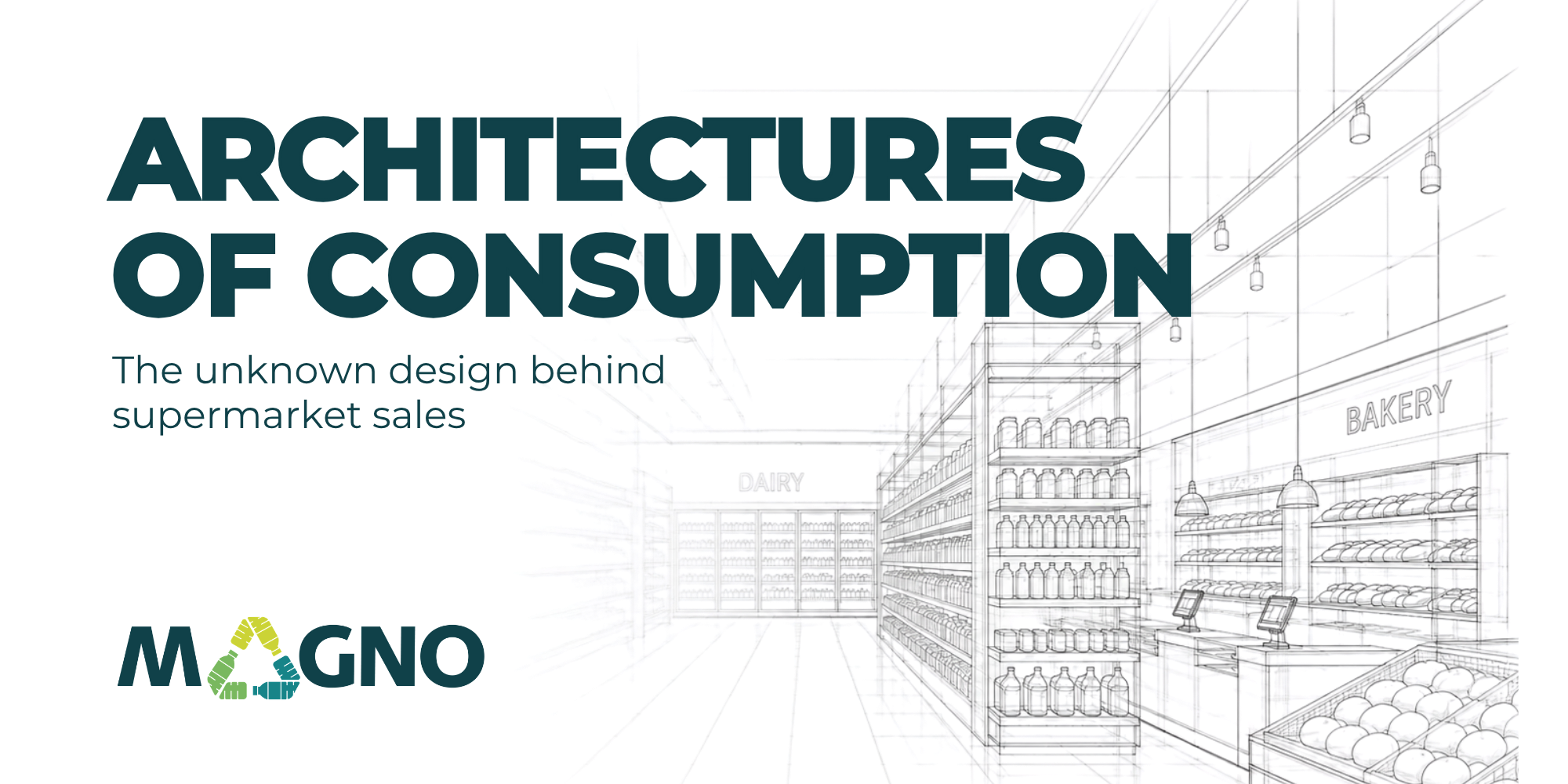
But the reality is that supermarkets, although they may appear austere, are among the most carefully designed buildings of contemporary life. Their architecture is not accidental: every aisle, shelf, product placement, colour, smell, promotional sign, even the music playing in the background… everything has been designed to influence consumers (you and me), shaping how we behave, how long we stay there, what catches our attention and what does not, and ultimately what we buy.
But what does this have to do with sustainability? Quite a lot, actually. In a space designed for some things to succeed and others not to, packaging becomes a decisive competitive factor. If it were not bright red with giant letters, how would you notice the product sitting on the lower shelf? Supermarkets are spaces where consumption habits are continuously produced and reinforced, often in ways consumers do not even perceive. But let’s take a walk through our local supermarket together and analyse it.
The first thing you usually see when entering most supermarkets is the fresh produce section: fruit, vegetables, and sometimes bakery products. Why? Because it immediately creates a feeling of freshness, abundance, and health. Before you even throw your favourite industrial pastries into the trolley, you have already absorbed the impression that the environment surrounding you is natural and trustworthy. And this emotional atmosphere matters. It matters because it shapes how people feel about the products around them.
As you continue walking through the supermarket, the organisation of attention becomes increasingly visible once you start paying attention to it. Products placed at eye level are usually the most profitable ones because they are the easiest to grab and the hardest to ignore. Cheaper alternatives are often placed on higher or lower shelves, requiring more time and effort to find, especially considering that most of us shop in a hurry. Position influences behaviour far more than we think, and this is not just opinion, it is data: if a product is moved from eye level to hand level, sales drop by 20%; if it moves from hand level to the floor, sales drop by 40%. On the other hand, moving a product from floor level to eye level can increase sales by 78%, while moving it from hand level to eye level increases sales by 63% (GS1 México, 2018).
Attention inside a supermarket is organised almost like an invisible choreography. Nothing is placed simply “where it fits.” Products generating higher profits tend to occupy the hottest areas of the store, while more basic or less profitable items are relegated to secondary spaces. Even the ends of aisles, the so-called endcaps, are premium locations because they catch our attention the moment we turn a corner. Brands pay enormous amounts of money for these spaces because they know visibility changes behaviour. Dramatically.
But this does not end with product placement. Packaging then enters the scene as a central actor. In an environment where hundreds of products compete for just a few seconds of attention, packaging stops being mere protection and becomes a psychological tool. Green colours suggesting sustainability even when the product itself may not be particularly sustainable. Transparent windows communicating freshness and honesty. Minimalist typography implying premium quality. Images of farms, leaves, wood, or nature printed on highly processed materials. Everything communicates something. Everything attempts to generate an immediate emotional response.
And it works especially well because most decisions we make in supermarkets are not rational, but fast. We shop tired, hungry, rushed, and thinking about a thousand different things at once. Supermarkets understand perfectly that an exhausted consumer looks for simple signals to make quick decisions. This is why the most visible products are often also the most convenient ones: ready-made meals, single portions, pre-washed products, pre-cut food, items wrapped in multiple layers to facilitate immediate consumption. Packaging becomes a silent promise: saving time, avoiding effort, simplifying life.
The problem is that this convenience carries enormous material consequences that usually remain invisible during the shopping experience itself. Because supermarkets are designed precisely so that we do not think too much about them. When you buy a tray of pre-cut fruit or a prepared salad, waste does not yet exist in your mind. You only see convenience. The plastic, transportation, constant refrigeration, complex logistics, or potential food waste only appear later, once you are back home and responsibility suddenly seems entirely yours.
Even promotions follow this logic. The famous “2-for-1 offers,” “family packs,” or “value formats” generate the psychological sensation of making smart decisions, even though many times we end up buying far more than we actually need. And this directly impacts both food waste and packaging waste, because the larger the volume purchased, the larger the volume of associated materials tends to be as well.
All of this leads us to an uncomfortable conclusion: perhaps we have spent years discussing sustainability as if it depended solely on individual consumer responsibility, when in reality many of our decisions take place inside environments specifically designed to guide our behaviour. A consumer may genuinely want to reduce waste, buy more sustainable products, or avoid unnecessary plastics, but if the most visible, accessible, and convenient options remain the least sustainable ones, then the decision is never completely free.
This is why projects like MAGNO matter. Because they understand that the packaging problem is not simply a matter of materials, but of entire systems: design, logistics, behaviour, business models, regulation, and consumption habits all functioning together at the same time. Sustainability is not only about inventing a better plastic, but also about rethinking the spaces where consumption happens and the dynamics shaping how we choose.
Because if supermarkets helped build a culture based on convenience and disposability, they could also become spaces capable of normalising other ways of consuming. The real question is not whether consumers want to behave more sustainably. Increasingly, many people do. The real question is whether the environment itself is truly designed to make that possible.