
Promotion of non-use of packaging: Reducing reliance on packaging by making informed choices
Written by: Phil Rosenow
Have you ever wondered if all the food packaging we see in the markets is really necessary? Indeed, farmers markets and specialized “unpackaged” stores offer many staples without packaging! And even supermarkets often offer at least loose produce. This contrast raises a simple question that many of us don’t stop asking: Where can we safely not use packaging for our food?
Let’s get start by making a distinction between packaging and a container. No one would simply pour oil or flour into a shopping bag after all. A container keeps things together. Packaging does a bit more: among other things, it often gives us standardized amounts of the food inside, comes with a barcode to make checkout much faster and provides protection for the food. This protection is not just against things like dirt, but also against oxygen and humidity, either or both of which may shorten a food’s shelf life, depending on the food. Let’s go through these three points:
- Portioning: packaging usually comes with a certain amount of food, say 1 kg of flour. Of course, this makes things easier for the producer, but also for the cashier at the market (no weighing). While usually somewhat reasonable, the amount you get in packaging might not be what you actually need. So, buying non-packaged might be more tailored to your needs. Less waste, more control.
- Barcodes: now these are mostly a matter of speed and convenience at check-out. They are missing for unpackaged food. While a relative rarity in supermarkets, this is an omnipresent factor in stores dealing in unpackaged food. But perhaps slowing down a bit is not a bad idea.
- Protection: here things get really interesting. Packaging provides protection and extends shelf life. Since the production of food uses much more resources than the production of packaging, this is a very important factor to consider. After all, we do not want to increase food waste. Plus, we want the food we eat to be safe, that is to say unspoiled. Protection is where packaging earns its keep—but also where it’s most misunderstood. For the remainder of this article, we will mostly focus on this.
Now that we have zeroed in on the protection of food as the main contributor to waste avoidance, how can we best select foods that we can safely buy unpackaged? There are two main factors to look into: the actual need of a given food to be kept for long enough, and the time we actually need the food to last.
How can we guess how much protection a food really needs?
Looking at packaging can help us make an informed decision on whether it is really needed or is just there for convenience. So, let’s start at the produce section. If we can get the same items both packaged and unpackaged, we can make a good guess that the packaging is mainly there for convenience (portioning and quick check-out) and is not needed for shelf life. Carrots or bell peppers, for example, are often sold in bags or loosely. Exceptions are “squishy” foods (like berries) and pre-cut fruits and vegetables (which benefit from restricted access to the atmosphere).
Photo from PxHere, licensed under Public Domain List
The convenience factor becomes a lot more obvious when we look at “open” packaging. Onions and potatoes are often sold in nets – the net really does nothing more than contain the food for convenience. Here, it is much more important for shelf life to store the food properly (in this case dry, dark, somewhat cool and ventilated) than to use protective packaging.
Moving along from the produce section to slightly more processed items, we arrive at staples like flour, pasta, sugar, and similar products. These have in common that they are loose by themselves and require a container to be transported. Looking at common packaging, we are often confronted with rather simple bags, often made from paper or very thin plastics. This is a good indicator that packaging fulfills more of a convenience role than a protective one. Indeed, things like flour should be stored dry, but are otherwise quite robust. Thus, bringing our own reusable containers to the store and buying whatever amount we need is perfectly viable for these staples. The same goes for dried legumes and similar types of food.
How long does it need to last?
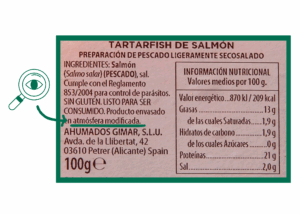
So far, we have mostly looked at foods that can last quite a while. What about more sensitive foods? Here, the time to consumption becomes more critical. How can we recognize these? As a rule of thumb, the packaging of these types of food is a good bit more complex than in previous cases – but this is not always obvious. If the packaging contains a visible metal layer, there is a good chance that the packaging has a genuine protective function. In other cases, a look at the label may prove illuminating. If the label mentions a modified atmosphere (MAP, Spanish: “atmósfera modificada”, Italian: “atmosfera compensata”, German: “Schutzatmosphäre”), the product is likely sensitive to air and the packaging needs to maintain the modified atmosphere for a while, if long shelf life is necessary.
Take a moment to think: would you treat a cut of meat bought fresh at the counter or butcher the same as the one you bought packaged? Which one would you trust to keep longer? Probably, you will use the fresh one much faster. And indeed, fresh meat can safely be kept for a short while, if it is properly cooled, but will perish faster than meat packaged under a modified atmosphere.
Many dairy products can be handled similarly. Cheese, for example, can be bought at the counter, stored in the fridge and used over a few days, without requiring packaging (depending on the cheese, of course).
Foods with a high fat content are often sensitive to oxygen (oxidation of fats makes them rancid), but this also depends on their consistency and the presence of natural antioxidants. Nuts can be susceptible to oxidation, especially if their shell has been removed. But nuts in their shell can again be purchased unpackaged and kept for a while.
Freshness and more
All in all, looking at common packaging and being mindful of our expectations for shelf life can be very helpful in making well-informed decisions on whether to buy unpackaged food. Choosing unpackaged is not just a question of sustainability—it’s a way to reconnect with what we eat and where it comes from. Buying from unpackaged stores, farmers’ markets or farm shops can support small, local businesses, many of whom might sell fresher and possibly better-quality products than you would get from the next supermarket. It’s a small change in habit that strengthens communities, reduces waste, and brings us closer to a truly circular way of living.
Do you often go to shops for unpackaged food? If not, maybe your next trip to the market could be the perfect place to start.