

How NGOs Can Build Awareness That Truly Works: Structuring Messages for Real Impact
It’s not that people don’t care. It’s that our attention has become one of the scarcest resources we have. Most of us give a video just a few seconds before deciding whether to keep watching or move on. By the time the message arrives, our mind is often somewhere else. Overwhelmed. Distracted. Tired. So what happens? We protect ourselves. We retreat into our comfort bubble. We keep scrolling. And this raises a critical question for NGOs working on sustainability, justice and social change:
How do you connect with a population that feels more informed than ever, but also more disconnected than ever?
-
Start With a Real Human Story
People don’t engage with abstract problems, they engage with other people.
Instead of opening with technical explanations or broad statements, NGOs can begin with something recognisable: a moment, an experience, a small tension that feels true. A mother choosing between convenience and sustainability. A student frustrated by single-use waste on campus. A consumer confused by contradictory labels.
A story is the doorway.
Once the audience can empathize, they’re willing to follow.
Taking into account distance between food packaging and humanitarian emergencies, a powerful example of this storytelling approach is Save the Children’s “If London Were Syria”, which places a familiar setting in an unfamiliar crisis, helping viewers emotionally understand something they might otherwise scroll past:

If London Were Syria – Save the Children Campaign
-
Make the Message Simple (Not Simplistic!)
For most people, the first seconds of a message determine whether they stay or scroll. A strong message answers, quickly and clearly:
- What’s happening?
- Why does it matter to me?
- What can be done?
Simplicity is not about removing meaning, it’s about making meaning reachable. When people understand the core idea quickly, they’re far more willing to stay with you long enough to absorb the nuance.
A clear example of this communication style is the campaign Water for Africa: Marathon Walker. In just a few seconds you understand the problem, the emotional weight behind it, and the action the viewer is invited to take. There is no overcomplication, only clarity with purpose:
 Marathon Walker – Water for Africa Campaign
-
Focus on Emotions Before Actions
Emotion is what makes someone pause instead of scrolling. It creates a sense of relevance: this affects me, this reflects something I care about. When NGOs connect their message to values like fairness, safety, responsibility or community, the audience understands the issue not just with the mind, but with the gut.
This doesn’t mean exaggeration or drama. It means acknowledging people’s everyday experiences; their frustrations, their concerns, and their hopes. When people feel recognised, they’re more open to understanding the message behind the emotion.
Emotion opens the door to understanding, and understanding opens the door to action.
An excellent example of this approach is an Alzheimer awareness campaign that tells the story of a grandfather and his grandson. Instead of presenting data or medical explanations, it invites viewers into a tender, familiar relationship:

Alzheimer Awareness Campaign – Fundación Reina Sofía
-
Frame the Problem, But Don’t Stop There
Awareness without direction often leads to paralysis.
When people only hear about the severity of a problem (plastic waste, pollution, inequality, climate impacts) the natural response can be to shut down. If everything feels too big, too urgent or too complex, it becomes easier to look away.
That’s why impactful campaigns go beyond simply exposing the issue. They create a sense of orientation and possibility. They: name the challenge, show that solutions exist, make people feel that change is genuinely possible
When communication stops at the problem, it discourages. When it includes a path forward, it empowers.
Possibility is a powerful motivator.
An example of this is Keep Britain Tidy’s campaign It Only Takes One. The video presents the issue of littering in a way that feels familiar and overwhelming but quickly shifts the narrative to a single achievable action: one person choosing to act can trigger a chain reaction. It transforms a large social problem into something people can influence, showing that change starts with the simplest step:

It only takes one – Keep Britain Tidy Campaign
-
Use Concrete, Everyday Language
Concepts like “circular economy,” “value-chain transformation” or “upstream interventions” are important, but on their own, they rarely connect with people’s daily lives. For most audiences, these terms feel distant, technical, or even intimidating.
Awareness grows when NGOs translate complexity into something people can relate to, something that speaks to their routines, concerns and decisions. Clarity is an act of care.
A great example of this is the short film Pequeñeces, created in the Comunidad Valenciana to promote local commerce. The message is direct, emotional and instantly clear: supporting your local shopkeepers matters, and it matters today. No complicated explanations, just a simple idea told in a way anyone can grasp.
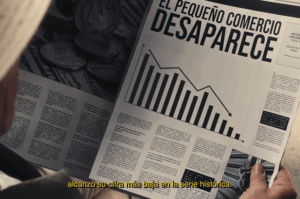 Pequeñeces – Confederació de Comerç de la CV
-
Offer One Clear Action
When people feel overwhelmed, they freeze.
If a message ends with a long list of instructions or too many requests, the easiest response is to do nothing.
That’s why effective campaigns focus on one simple, concrete action.
Just one. Something realistic, accessible and easy to understand. When the next step feels achievable, people are far more likely to take it, and that first step often opens the door to deeper engagement.
A great illustration of this principle is the campaign Ring the Bell against domestic violence. Instead of overwhelming viewers, it offers a single, powerful action that anyone can take: ring a bell when you hear or see signs of abuse. The simplicity of that request is exactly what makes it effective:

Ring the Bell – Breakthrough Campaign
-
Keep the Dialogue Open
Awareness is not a monologue, it’s a conversation.
If communication only flows in one direction, NGOs risk sounding like unquestionable experts delivering absolute truths. But real life isn’t that simple. A message that seems obvious to one person may feel unrealistic or irrelevant to another.
That’s why listening is just as important as informing.
Keeping the dialogue open means creating space for questions, doubts, suggestions and personal stories. That’s why opening channels for direct contact (whether through surveys, hotdesks, feedback forms or community spaces) helps NGOs understand what truly matters to their audience. It transforms campaigns from one-way broadcasts into shared problem-solving.
A powerful example of this approach is Amnesty International’s global campaign Write for Rights. Each year, people from around the world write letters to support individuals whose rights and freedoms are under threat, and they also write directly to authorities demanding protection and justice. The campaign shows how awareness becomes meaningful when people are invited to take part in the conversation and contribute with their own voice:
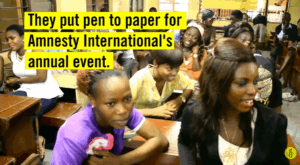
Write for Rights – Amnesty International Campaign
-
Communicate With Ethics: No Victims, No Saviours
There is another essential dimension to effective NGO communication: ethics.
Too often, awareness campaigns fall into two traps:
- Victimising the people affected
Showing individuals or communities only through their suffering may get attention, but it strips them of agency. It reduces complex human experiences to a single image of helplessness, and that does not honour their dignity nor their resilience.
People are more than the problems they face.
Ethical communication shows challenges and strength, barriers and efforts, difficulties and the capacity to act.
- Slipping into the “white saviour” narrative
Another trap is framing the NGO (or those funding or leading it) as the heroic rescuer of passive communities.
The goal of awareness is not to show who saves whom.
It is to show how change happens when people, communities and organisations work together.
What ethical communication looks like
Ethical NGO messaging:
- highlights agency instead of helplessness,
- centres the voices of those affected,
- shows collaboration instead of rescue,
This creates deeper trust, and a form of awareness that empowers instead of exploiting emotions.
An example of communicating with ethics is the satirical campaign, Soul Gym. In the video, viewers are invited to subscribe to an imaginary gym in Africa and are told that, just like with any gym membership, they will probably not show up, yet they will feel good about themselves because their subscription will be supporting Babies Uganda:
 Soul Gym – Babies Uganda Campaign
Take aways for NGOs
In a world saturated with messages and shrinking attention spans, impactful awareness requires intention. NGOs can cut through the noise when they communicate with clarity, emotion and purpose:
- Start with stories.
- Speak simply.
- Connect emotionally.
- Show possibility.
- Invite action.
- Keep listening and do it ethically
Is not only about goals, also about means.