
Encouraging zero-waste shopping: Tips for consumers to adopt waste-free habits
Written by: Phil Rosenow
What if we did not have any packaging waste at all? Or, at least, as little as possible? Of course, when we talk about food, packaging is not the only possible waste. Food waste can also come up and when it does, it is usually worse than the packaging, if we look at the environmental impact. So, if packaging can reduce food waste, it is generally “worth it”. But what about cases where packaging is used more for convenience? Maybe we can avoid it there.
Shopping bags
While not technically packaging, plastic shopping bags are a common occurrence despite all efforts to get rid of them. With all problems they pose if they get into the environment, they have a few things in their favor. For one, they are cheap and convenient. They can typically be used a few times and if they outlive their use as a transportation aid, they might find a final use as a garbage bag. Looking at the efforts required to produce shopping bags out of plastic, paper or cloth (cotton), plastic bags actually consume the least amounts of resources and energy of the three; cotton bags need a lot of water, for example. Of course, plastic has the major downside of being a disaster if it ends up in the environment. Rather than decomposing, it will stay around for hundreds of years, grind down to small particles, including microplastic, and might present a hazard for wildlife on the way.
So, what about paper bags? It has been estimated that paper bags need to be used at least three times for their carbon footprint to break even compared to a plastic bag (it might even be a few dozen times, depending on the details). Fun fact: the modern plastic bag was invented in the 1960s, partially to prevent deforestation for the production of paper bags. Still, a paper bag has a big advantage should it end up in the environment: it will decompose. Which also means that they can find a final use as a bag for composting waste, rather than a general garbage bag.
With cotton bags, the reuse numbers to balance the production compared to plastic bags are even higher, with estimates of 131 uses. On the plus side, a cotton bag can be used several hundred times. Given the amount of water required to make them, not to mention the use of herbicides in cotton farming, giving them as many cycles as possible sounds like a good idea. This ties directly to what we explored in our earlier article, “Choosing Reusable over Single-Use.” The famous cotton tote may start with a heavy footprint, but reusing it flips the story.
Plastic, paper or cotton, what will it be? Regardless, using a shopping bag only once is a bit of a waste in any case. While no one wants their bag to tear and spill their groceries all over the place, as long as the bags are still good, reusing them is recommended. And plastic or paper bags can be used as garbage bags, as mentioned above. A cotton bag (perhaps a souvenir?) is the most effortful to make out of these options but can also be used many times and can carry more than just groceries. All in all, any option can be useful if it is used mindfully and repeatedly, and if it is disposed of properly – littering is a poor option in any case. There are, of course, some additional options: traditional materials like jute (burlap) might still be found and baskets can also be used many, many times. Finally, plastic bottles are usually made from polyesters (PET) and can be recycled into reusable bags which may last through many uses as well.
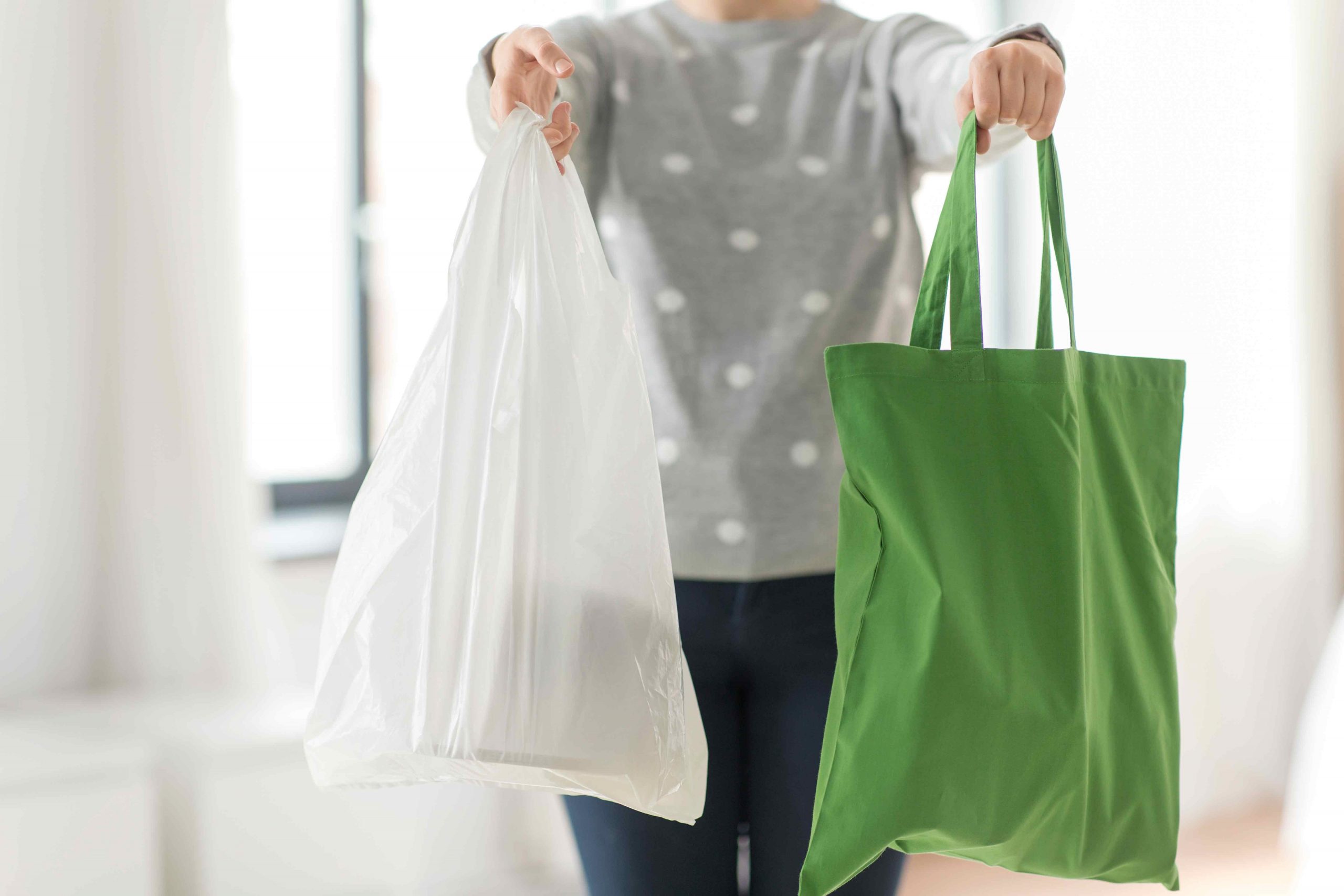
Photo from Roboflow Universe, licensed under CC BY 4.0
Fresh fruits and vegetables
Why are fruits and vegetables sometimes packaged? After all, they come with their own shell! Well, it is possible to extend the shelf life of fruits and vegetables by packaging them in such a way, that their metabolism is slowed down, making them ripen more slowly and staying fresh longer – but this is not achieved by most usual packaging. Quite often the answer is probably convenience. After all, a one kilo net or bag does not need to be weighed at the checkout, and the tag can simply be scanned. So mostly, packaging fresh fruits and vegetables is not really necessary.
There is, of course, an exception to every rule. Berries are quite squishy, so putting them in a protective case is not a bad idea. But this does not have to be plastic. A paper tray can work just as well for mechanical protection. On the downside, paper trays are often heavier than their plastic counterparts, making their transport a bit more resource intensive. They might also take up more resources to make.
Above we mentioned that packaging can increase the shelf life of produce, but this is seldomly done. However, there is one exception which looks strange at first glance: cucumbers wrapped in plastic. The plastic wrap reduces the amount of oxygen available to the cucumber, which in turn breathes and, more importantly, ripens more slowly than without it. So, it takes longer to go bad. When does this help? As Swiss researchers showed, for locally produced cucumbers, the wrap is unnecessary, even ecologically harmful. For those that are transported long distances, on the other hand, the avoided food loss outweighs the production of the wraps. Of course, the wrap should be disposed of properly and not wind up in the environment. All in all, this sounds like a good argument to buy locally, if possible.
Another case are staples like potatoes or onions, of which we usually need a lot. Those often come in nets which is convenient to be fair. While these nets need less material to make than bags, they are usually not recyclable. Depending on the number of individual potatoes one wants to buy, it may not be feasible to pick them up one by one. This brings us back to the shopping bags: a reusable net (or bag or basket) gives us the needed container without too much hassle. This way, we can also pick out the potatoes (or others) we want and maybe even get some better ones. Also, did you know that a bit of dirt on a potato extends its shelf life? You do not get that in a bag.
Where does this leave us? In general, buying locally produced, unpackaged fruits and vegetables will be the most sustainable option – no surprises there. When it comes to produce from further away, packaging may be useful but most of the time, going unpackaged is an option here as well. And for convenience, bringing reusable nets or bags helps to save resources in the long run.

Photo from PxHere, licensed under Public Domain List
Buying unpackaged
Apart from fruit and vegetables, can we buy more unpackaged foods? Sure, if stores offer that option and we bring our own reusable containers. Which foods lend themselves to this kind of shopping? Well, oftentimes, packaging is not just there to keep everything together, but also to provide protection from external factors that might lead to spoilage or deterioration. This is not just dirt, but also oxygen, humidity and/or light. Foods that need this protection to last long enough to be consumed generally benefit from their packaging; everything else is fair game for packaging-free shopping. Let us look at some examples:
- Dried foods, such as flour, sugar, pulses, legumes and more: These types of food need to be stored dry but do not draw in so much water that they must be completely sealed off. Here, packaging is mostly a question of convenience – of course, these goods cannot be sold loosely. This makes them good candidates for storage in larger containers at the store, where customers can come with their own containers and buy by weight.
- Nuts and seeds: These are mostly similar to the dried foods above. However, since nuts and seeds contain lots of oil, they can be susceptible to oxidation (where they can become rancid), so packaging them is quite useful if they are to last for a long time – sometimes, even modified atmosphere is applied to extend the shelf life of certain nuts. But for quick consumption or use, buying them unpackaged is certainly an option. And while not the healthiest choice, a chocolate coating can work just as a tasty packaging.
- Meat: This is an interesting one. For meat, chilling is quite important, as the most important spoilage mechanism is the growth of bacteria. This can be slowed down by using a modified atmosphere (tailored to the type of meat), which of course requires packaging. But this mostly applies to meat that needs to be stored for more than a few days. So, meat that is bought freshly from the counter or butcher, and used within a short time can comfortably be put in a simple wrap. If it needs to stay fresh a bit longer, the packaged meat might be the better choice – though freezing can work, too.
- Cheese: somewhat like meat, the amount that will be consumed within a reasonable time can easily be bought unpackaged from the counter and refrigerated. Some cheeses might still be ripening and require specific conditions that packaging can provide, but if they do not need to be kept for long, the packaging is not strictly necessary. Cheese is like meat in the sense that microorganisms are often behind their spoilage, only is it usually mold – which is also a key ingredient in some cheeses. If mold is not required to be on the cheese, similar considerations to meat apply – some packaged cheese also comes with modified atmosphere.
- Bread: Few things smell better than fresh bread. But a big loaf might go bad before it is finished. What can happen to bread? Well, it might dry out or start growing mold, depending on the conditions under which it is stored. Still, it can be bought fresh from the baker without much packaging. As it is well known, bread can also be frozen to keep it longer.
- Oil: Oils are another product that obviously requires a container. But this can be reusable if a store offers this service. The advantage here is that less packaging needs to be carted around (glass bottles, which are often used for oil, weigh quite a bit and need a lot of energy to be transported). To keep the oil in good quality, a darkened bottle is recommended, as oil can degrade under UV light.
This is by no means an exhaustive list but contains some common examples.

Photo from Flickr, licensed under CC BY-NC-SA 2.0
Preventing waste
What can we take from this? A lot of food packaging can be avoided by going to the deli counter, stores that specialize in unpackaged shopping or the good old farmers’ market. On the other hand, the protective function of packaging does not always make this as straightforward as one might think. Instead, many hidden complexities are hidden in the packaging going beyond mere convenience. Generally, buying regionally (and seasonally) produced fresh foods that are consumed quickly enough can be done without packaging. Products that are very sensitive to environmental factors, come from far away or need to last longer are a different matter. While there is no problem with the occasional strawberry in winter or avocado, locally produced food in season will be the most sustainable choice most of the time – and can come (almost) waste-free.