

Supporting products with minimal or no packaging: Highlighting low-waste brands and alternatives
Written by: Phil Rosenow
Think of your favorite grocery item (or anything that comes in a package, really). Now picture it once in very elaborate packaging, one worthy of an unboxing video on social media, and once in more humble, simple packaging. Which one do you get? Assuming both protect the content equally well, the simple packaging is going to be the more eco-friendly choice, as it produces less waste. Yet, the other one might seem more valuable, especially if the product itself is to be perceived as such – a trick that premium brands know all to well.
This everyday dilemma shows how packaging influences not only waste but also how we value products. With this in mind, let’s explore some low-waste alternatives to common items, and see what lessons we can take as consumers.
Potato Chips
What do we think of when we picture packaging for potato chips? Usually, it will be some kind of tube (the famous Pringles can) or a bag. Upon closer inspection of the latter, the inside of chips bags is often quite metallic looking. That is because the classical chips bag is a rather elaborate structure with a metal layer for high protection with plastic on either side (plus a printing layer on the outside). These compound materials have high protection against oxygen, water vapor and light. Why is that? Well, we want chips to be crunchy, so they need to be kept dry – if they get to much humidity, they will get soft. Chips are also fatty, and fats are susceptible to oxidation (specifically unsaturated fats so oxidation makes the fat not only less nutritious but also taste rancid). Finally, light can accelerate this oxidation of fatty acids, especially if there are spices that act as photosensitizers, the popular paprika being an example. In addition, chip bags usually contain a lot of air which serves as a cushion for the chips and needs to be retained. All in all, this very complex material seems to do the trick. There is just one downside: it is not that great for recycling.
So, if we examine the demands of potato chips more closely, keeping water vapor out is pretty much non-negotiable – no one wants soft chips. Oxygen is a bit more variable – as long as the package provides enough protection against oxidation, it is really enough. And without photosensitive spices, light protection is also not necessary. Taking all of this together, chips packaging can be made really simple, on the market usually from polyethylene (PE). PE has a very good barrier against water vapor; oxygen can pass through quite well though, but this seems not to be the biggest issue. We will look at some brands that use this kind of packaging – by no means an exhaustive list and no endorsement is intended.
Starting in France, “Les Chips de l’Aveyron” sell their chips in a clear bag with very simple printing – less printing is generally more favorable for recycling. They offer a range of different flavors, including some with colorful spices, so even photooxidation seems to be less of an issue here.
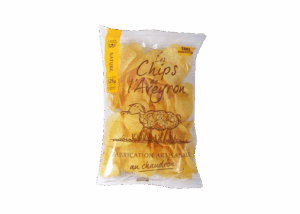
Photo from “Les Chips de l’Aveyron” website.
A similar approach seems to be used by the Italian “Amica Chips”, some of which come in mostly transparent bags. In comparison, they have a bit more print. This will affect recycling a little bit, but compared to the fully metallized bag, this one will be much easier to handle. Not the topic of this little article, but they also claim the use of recycled material in these bags.
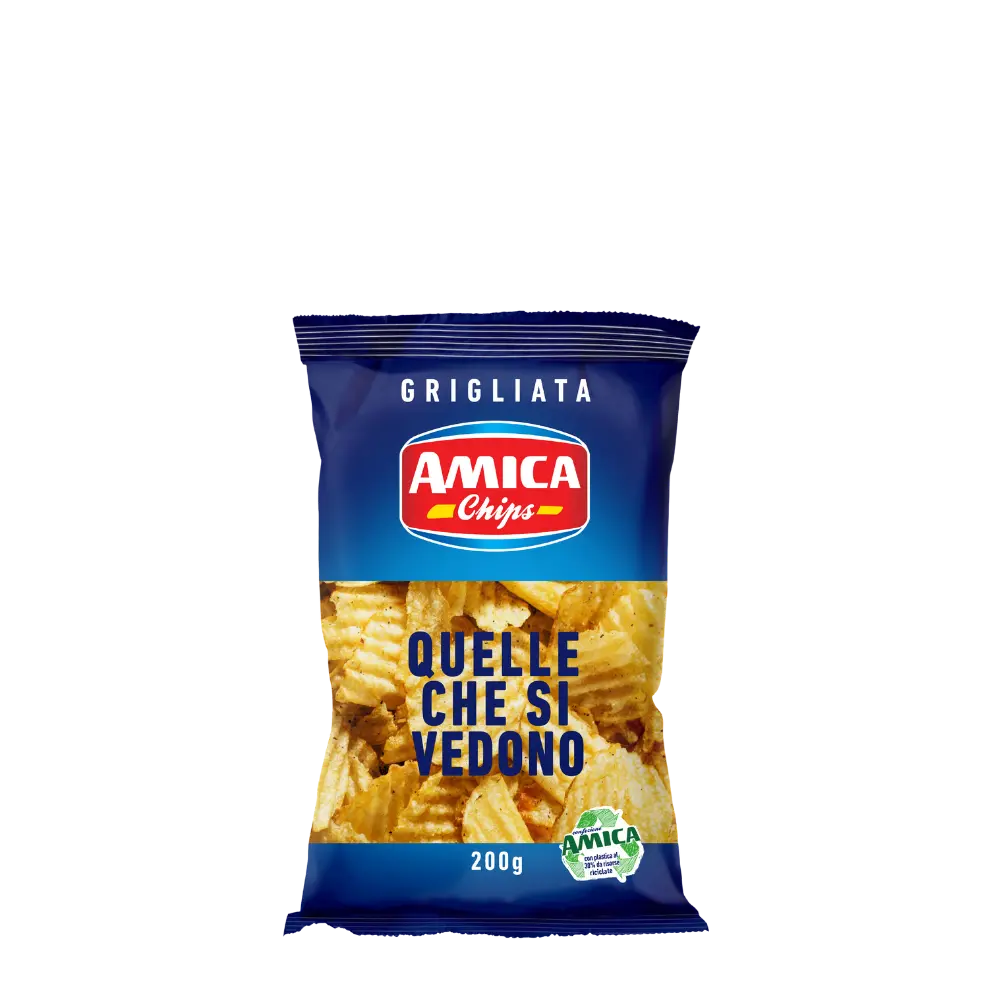
Photo from “Amica Chips” website.
As a final example, the German company “Chipzz” uses completely outsources the print onto a paper bag and puts a completely clear bag with the chips inside. The plastic bag provides protection against humidity and, due to the lack of printing, are expected to be highly recyclable. The paper bag provides some protection against light and can be recycled on its own. Since the two are not glued together, separating them is easy. On the downside, the paper bag adds a bit more material.
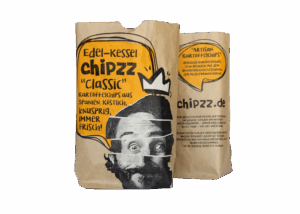
Photo from “Chipzz” website.
What about avoiding plastics, or at least fossil plastics, altogether? Here things get a bit tricky. As we established, keeping humidity away from the chips is crucial for long time storage – something that plastics like PE are really good at. Alternative materials, such as most biopolymers, often lack the water vapor barrier required by chips, making them less suitable. Paper alone also does not do the trick, so it needs to be coated with something to fill the gap in functionality, often leading to complex builds that are hard to recycle – or not at all. One attempt at a solution made from paper with a metal layer (almost) directly on the paper is on the market but it seems like it may need more work. Such a metal layer is fragile and paper shrinks and expands with changing humidity, easily leading to cracks in the metal, nullifying the protective function.
Mayonnaise
Mayonnaise often can be found in a glass, a sturdy plastic bottle or a metal tube. The glass is heavier, meaning production and transport probably have a much larger impact than the plastic bottle. On the other hand, a glass can be emptied easily with a spoon. In plastic bottles, there are often some annoying residues near the neck, which can only be scooped out by cutting open the bottle – not without risk, given the thickness of the wall. The metal tube can be squeezed empty easily but uses again materials that need quite a lot of resources and energy. An alternative comes from Japan: a mayonnaise plastic bottle with walls so thin, it is almost a tube. This can be rolled up, squeezing out the remaining content. At the same time, it uses less material and is much lighter than the usual alternatives.
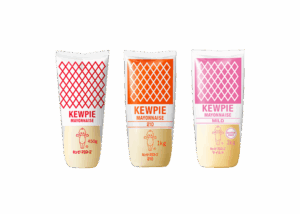
Photo from “Kewpie” website.
Minced meat
Minced (or ground) meat can be bought fresh from the deli counter or prepackaged. Which to choose? And what has changed for the prepackaged one? To answer the first question quickly, if the meat is used up within one or two days after purchase, it is generally the environmentally better option. If it is to be stored for longer, the prepackaged one is usually packaged under a modified atmosphere to keep harmful microorganisms at bay. Thus, it lasts longer than the unpackaged one and is the better choice – after all, producing the meat consumes much more energy and resources than the packaging.
One interesting thing can be observed for the packaging of ground meat. Some years ago, it was often packaged in a tray that was tightly sealed with a lid. Nowadays, a simpler type of packaging without a tray is the norm (a so-called flowpack). These use less packaging material (about one third compared to the tray) and provide protection just as well. They are also a bit more compact, allowing for more efficient transport, and well recyclable. While product protection is paramount, this is a good example of how to minimize packaging for positive impact.

(Imagen: Handtmann)
What to look out for?
A few general pointers to recognize minimalist packaging can be easily given:
- If the same type of product can be found in thinner packaging (and the latter one is just as good), the thicker material is probably a choice to imply higher quality. Saving the extra material might well be worth it.
- Unless the product needs to be protected from light, the less print the better. It might not seem like a big deal, but the printing inks show up in recycling. Marketing might have something to say about this, though.
- Refill packages can be found for spices and some cosmetics products. These often come in bags which can be emptied into a sturdier can – if they are used this way, they use less packaging material in total.
- Not everything needs to be packaged. Where packaging-free options are available, they are a good way to save waste. More about that will come in the next article.
Conclusion
Packaging is everywhere — so common we barely notice it, until it piles up in the bin. But behind every wrapper there’s a design decision: to make things simple, or to make them complicated.
What these examples show is that simplicity often works just as well, sometimes even better. And when simplicity means less waste, that’s a win for everyone.
Imagine if the “special edition” became the one with no frills, the one that quietly protects the product and leaves nothing behind. Maybe one day, the packaging we barely notice will be the packaging we value most.